Pure Yoga (菩尔瑜伽)is devoted to serving the yoga community in Asia and beyond,offering a wide variety of classes such as Hatha Yoga,Hot Yoga,Yin Yoga Vinyasa,etc. Our yoga classes are offered and taught by nearly 200 professional yoga teachers. Private Yoga is also available for learners of all levels. Pure Yoga constantly invites world-known teachers to lead guest teacher workshops.
Class Booking
Class bookings can be made 2 days in advance of the class. It is important that you book your class in advance since some classes are more heavily attended than others.
We also limit our class sizes so that they are not overcrowded. If a class you wish to take is full, we will place you on the wait list and inform you of an opening as soon as possible. To create the best experience for yourself and others,please follow these guidelines:
No talking
The yoga studio is a silent room. Please do not talk while in the studio and studio corridors(走廊).
No eating
Do not eat in the studio.
No shoes
Remove your shoes before entering the practice rooms. Keep your shoes in your locker (寄存柜).Shoe lockers are also available for rental.
No mobile phones
Turn your mobile phones off or to “vibrate”(震动)mode. Do not take phones into the practice rooms.
Personal Belongings
Daily lockers are not for overnight use. Locks from any daily lockers that are kept overnight will be cut.
Who will teach general learners yoga?
| A.favorite yoga teacher. |
| B.professional yoga teacher. |
| C.world-known yoga teacher. |
| D.private yoga teacher. |
When should you book your class?
| A.One month ahead of time. |
| B.Two months ahead of time. |
| C.Two days ahead of time. |
| D.One day ahead of time. |
In the practicing room,you can .
A.keep your shoes in the locker
B.wear any shoes you like
eat some snacks if you are hungry
C.talk with your friends on the phone
Child models are very much in demand all across the world. Many magazines and online stores that sell products for children like their models young.For this reason,they seek out children who can model clothing and have no problem posing(摆姿势)and smiling for the camera.Those who are seeking out child models for thelr advertising can go to online modeling sites and view plotures of children who are web models.They can take a look at their portfolio(整套照片)and decide whether they will accept them.
Parents who are seeking to get their children into the modeling business can also create a portfolio for ther children and put them online.They can look for jobs for their chldren through an online modeling site,or they can wait for job offers for their children.These online sites act as web modeling agency for models young and old alike.Anyone who has the desire to be a model can get a portfoilo to gether and join the site.
If you have a child who you want to be a model,you should frst stalt a portfolio for him or
her and Then join an online modeling agency.Once you join the agency,you can then start to look for jobs,Clients(客户)will post jobs that can be found in the search.You can look for jobs for young models and see if your child will fit what the client is looking for. In many cases,the client will send clothing for the child to wear and a descriptlon of poses and the job can be done close to home.
Online modeling agencies are not only for child models.Older models,teen models,men and women can model for these slies. A great deal of the modeling is for online websites.Ths is an entirely new field in the world of modeling and much easier to get into than the older modeling agencies.There is no traveling or expensive photo shoots needed.All that is needed to make children into models is a nice portfolio and a photogenic(上相的)child.
71. Child models are needed to____________.
A.Create more job offers
B.set the fashion for children
C.increase the sales of child products
D.manage online stores that sell teen magazines
72.The underlined Word "they" in Paragraph 1 refers to_______.
A.parents
B.chld models
C.online modeling sites
D.people looking for child models for advertising
73. What should parents do if they`d like their children to become models?
A.Train them to hold special poses.
B.Choose them beautiful clothes.
C.Take expensive photos of them.
D.Put their portfolio on online modeling sites.
74. Why are online modeling agencise popular?
A.Because They are easily accessible to most people.
B.Because they charge no fees for their service.
C.Because this is an entirely new field.
D.Because this can make a child more photogenic.
75.This passage is mainly about______.
A.a growing need for child models
B.an increase in modeling agencies
C.the change in the world of modeling
D.the attraction of the world of modeling
Garbage is unwanted or unusable materials. As long as there are people on the planet,there will be garbage Garbage is directly linked to human development,both technologically and socially.The composition of waste has yared Over time and location,with industrlal development.Examples of this include plastics.Some garbage has economical value and can be recycled once correctly recovered.
For most of us, "out of s ight,out of mind": throw it away and it`s gone.But imagine what really happens to all the rubbish the world throws away.Now suddenly,the government is worried about mountains of garbage piling up with no place to put them all.
China`s increasing prosperity and urbanlsm create tons of garbage since the 1980s,causing tons of trouble.The amount of paper,plastic and other garbage has increased more than three times in two decades to about 300 million tons a year.As busy families are shifting from fresh to packaged foods,more garbage is expected.
There are also a huge number of people who go through the garbage to find anything that can be of value and recycled!The recycling is carried out every day when peope come to your house to take away your newspapers and cardboard,plastic and metal items.Every neighborhood has a garbage point.Take a train trip and there are recycling yards all along the tracks in every city. Food waste is collected by farmers to feed animals.
Even though we make an effort to recycle our solid waste,the amount of waste keeps increasing each year.Our biggest problem is where to put the solid waste and how to keep it from polluting our environment.If the solid waste is disposed incorrectly,it can pollute earth`s surface an underground water supplies.Currently,Our municipal waste goes to landfills or garbage dumps.
The waste must be treated to keep rats,flies and other anlmas from building their homes in the landfills.The treatrment also prevents the growth of bacteria that carry diseases.
The government knows such garbage disposal(处理)will always draw complaints.What they need to do is invest more money into bullding and maintaining better evelironment.
66. In the eyes of the author,________.
A.garbage should all be thrown away
B.garbage can all be recycled for its economical value
C.every kind of garbage has its practical value
D.garbage is closely related to the prrogress of society
67.From the second paragraph we can infer that_________.
A.throwing away rubbish is the only way at present
B.mountains of rubbish appear everywhere
C.the government has trouble dealing with rubbish
D.lanudfill treatment is the best way at present
68. In the 1980s,the amount of garbage was estimated about _______.
A.300 million tons B.200 million tons
C.100 million tons D.50 million tons
69. The attitude of the author towards recycling waste is
A.unfriendly B.objective C.supportive D.disappointed
70. What will be talked about after the last paragraph?
A.The government will respond to the people`s complaints.
B.Proper ways to deal with rubbish will be found.
C.The government will take measures to control the public.
D.The rubbish mountains will be removed.
On April 16th,don`t be surprised if the womann next to you on the subway looks like she forgot to get dlessed for work.She won`t be alone.People in their pajamas(睡衣裤)will be spotted all across the country一traveling on the subway,in line for their morning coffee,and even walking into office buildings.That`S because people will be trading in their business suits for pajamas and celebrating National Wear Your Pajamas to Work Day.
There is nothng more comfortable than sitting at your desk in soft cotton flannel(法兰绒的)paiamas or wearing your favorite slippers while you deeply think about the day`s tasks,The PajamaGram Company,Which produces and sells pajamsa,believes that Americans need a break,especially the day aher income taxes are due.That`s why they are celebrating National wear Your Pajamas to Work Day.
Wearing pajamas to work can be re laxing and can actually help employees be more productive.David Alien,author of The Art of Stress-free Productivity,promotes(倡导)relaxation to increase Productivity."Our ability to be Productive is directly proportional(成比例的)to our ability to relax,"said Allen."Only when our minds are clear and our thoughts are organized can we achieve stressftee productivity."
At the Pajama Gram Company,it`s not unusual to find employees Wearing their pajamas at important meetings or at their desks.The Company even invented the term "life is bananas,send some pajamas," to describe how they feel about the world we live in.
The PajamaGrma Company offers over 100 styles of pajamas,robes,slippers and spa products.Each PajamaGram gift comes along with beautiful Pajamas,lavender(熏衣草)bath tea,Do-Not-Disturb sign for the door and a gift card.
61. On APril 16th,people in America often ____________.
A.forget to change pajamas for w ork
ork
B.do pajama business on the way to Work
C.go to wook in their pajamas
D.celebrate their traditional festival
62. People celebrate this special day because they are expected to
A.Work in a more effective way
B.increase their ability to relax
C.spend less on their daily clothes
D.have more time to rest
63. The underlined word "bananaS" in the last paragraph can be replaced by ___________.
A.easy and free B.happy and interesting
C.crazy and busy D.full of fruits
64. According to the passage,which gifts will you receive from the PaiamaGram Company?
a.a sleepwear
b.a beautiful box
c.a Do-Not-Disturb sign
d.lavder bath tea
e.a personalized gift card
A.c,d,e B.a,c,d C.b,c,d,e D.a,c,d,e
65. The main purpose of the passage is to _________.
A.advertise the PajamaGram Company
B.introduce a special day in America
C.describe the busy life In America
D.advise people to buy more pajamas
第三部分阅读理解(共20小题;每小题2分,满分40分)
Housing is always an important comcern,and things were no different back in Canada`s early days.The nailve population had several answers to the housing problem.
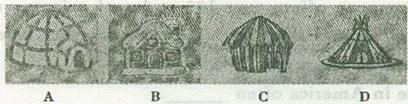
The igloo if a house built of ice or snow and is still in use today in more primitive areas of Canada`s north.The Inuit people find them the best type of housing,eSpecially when away from home on hunting or fishing trips.The igloos used o such trips are smaller and only temporary homes to be used for a few nights at most.Igloos are domeshaped(圆顶形的)and made of blocks of ice or snow.First a hole is dug out in the snow and this forms the lower part of the igloo.Then the blocks of ice or snow are built in a slope inwards and upwards from this base.Often a short tunnel leads to the door.This prevents the cold winds and snow blowing into the structure.
Tipis(or tepees)are the conical(圆锥形的)tents used by the majority of native People
across America.Some Canadian aboriginal people still prefer them to other types of housing. These structures are formed by a frame of poles covered with,usually,iether buffalo hide(水牛皮)or birch bark(桦树皮).A hole at the top lets out the smoke from the cooking fires.Native people mostly travel from place to place,following their food supple across the countryside.Tepees are easy to taKe down,carry and put up at the next stopping place.
Another type of house iS the long house.This is exactly what the name suggests-a long narrow building that could house ten to twenty families.Built of poles covered with hides,there houses are common to the Iroquois people of 0ntario and NeW York.These structures are also on the West Coast by the Squeamish Indians.They are usually occupied by an exended family and divided into individual rooms,each with its own cooking fire.They are decorated with totem emblems (图腾标志)and a totem pole by the front door tells the history of the family.
56.Which of the following pictures matches with the igloo?
57.The short tunnel leading to the door of an igloo is used to__________.
A.catch the animals B.decorate the igloo
C.fasten the igloo D.keep the gloo warm
58.Which of the following about a tiPi is NOT true?
A.It has a hole at the top.
B.It is made of poles covered with hides.
C.lt can be easily carried everywhere.
D.It has a firm base made of ice.
59. The underhned word "They" in the last paragraph refers to "________".
A.Squeamish Indians B.Long houses
C.Families D.Individual rooms
6o. Where can we most probably read this passage?
A.In a medical journal. B.In a science report.
C.In a culture magazine.D.In a biology textbook.
Taste is such a subjective matter that we don’t usually conduct preference tests for food. The most you can say about anyone’s preference is that it’s one person’s opinion. But because the two big cola companies-Coca-Cola and Pepsi Cola-are marketed so aggressively, we’ve wondered how big a role taste preference actually plays in brand loyalty. We set up a taste test that challenged people who identified themselves as either Coca-cola or Pepsi fans: Find your brand in a blind tasting.
We invited staff volunteers who had a strong liking for either Coca-Cola Classic or Pepsi. Diet Coke, or Diet Pepsi. These were people who thought they’d have no trouble telling their brand from the other brand.
We eventually located 19 regular cola drinkers and 27 diet cola drinkers. Then we fed them with four unidentified samples of cola one at a time, regular colas for the one group, diet versions for the other. We asked them to tell us whether each sample was Coke or Pepsi; then we analyzed the records statistically to compare the participants’ choices with what mere guesswork could have accomplished.
Getting all four samples right was a tough test but not too tough, we thought, for people who believed they could recognize their brand. In the end, only 7 out of 19 regular cola drinkers correctly identified their brand of choice in all four trials. The diet-cola drinkers did a little worse-only 7 out of 27 identified all four samples correctly.
Both groups did better than chance would predict, but nearly half the participants in each group made the wrong choice two or more times. Two people got all four samples wrong. Overall, half the participants did about as well on the last round of tasting as on the first, so tiredness, or taste burnout, was not a factor. Our preference test results suggest that only a few Pepsi participants and Coke fans may really be able to tell their favorite brand by taste and price.
71. According to the passage the preference test was conducted in order to___________.
A.show that a person’s opinion about taste is mere guesswork
B.compare the ability of the participants in choosing their drinks
C.find out the role taste preference plays in a person’s drinking
D.reveal which cola is more to the liking of the drinkers
72. The statistics recorded in the preference tests show that____________.
A.there is not much difference in taste between Coca-Cola and Pepsi
B.few people had trouble telling Coca-Cola from Pepsi
C.people`s tastes differ from one another
D.Coca-Cola and Pepsi are people`s two most favorite drinks
73.It is implied in the first paragraph that __________
A.the competition between the two colas is very strong
B.blind tasting is neccssary for identifying fans
C.the purpose of taste test is to promote the sale of colas
D.The improvement of quailty is the chief concern of the two cola companies
74.The underlined word "burnout" here refers to the state of __________
A.being seriously burnt in the skin
B.Being badly damaged by dire
C.Being unable to burn for lack of fuel
D.Being unable to function because of too much use
75.The author`s purpose in writing this passage is to __________
A.emphasize that taste and price are closely related to each other
B.Recommend that blind tasting be introduced in the quality control of colas
C.Show that taste preference is highly subjective
D.Argue that taste testing is an important marketing strategy
 粤公网安备 44130202000953号