Years ago, I lived in a building in a large city. There was another building not far from mine. A woman lived there. I had never met her, but I could see her sit by the window each afternoon, sewing(缝纫)or reading.
After several months, I began to notice that her window was dirty. Everything was unclear through the dirty window. I would say to myself, “What a lazy woman! I wonder why she doesn’t wash her window. It really looks terrible.”
One bright morning, I decided to clean my flat, including the windows. When I finally finished the cleaning, I sat down by the window for a rest. What a surprise! Everything in the woman’s flat could be seen clearly. Her window was clean!
I began to understand. I watched the woman’s window from my own dirty window. That’s the problem! That is quite an important lesson for me. How often do I look at and criticize others through the dirty window of my heart?
From then on, whenever I want to judge someone, I ask myself first, “Am I looking at him through my dirty window?” Then I try to clean the window of my own world so that I may see others’ world more clearly.What does the underlined word judge mean in Chinese according to the passage?
| A.赞美 | B.评判 | C.妒嫉 | D.鼓励 |
Why couldn’t the writer see things clearly through the window?
| A.Because the woman’s window was dirty. |
| B.Because his own window was dirty. |
| C.Because the woman lived far away. |
| D.Because he had poor eyesight. |
What can we learn from the passage?
| A.one shouldn’t criticize others very often. |
| B.one should look at others through his dirty windows. |
| C.one should often keep his windows clean. |
| D.one should judge himself before he judges others. |
Some people think only school children do not agree with their parents, however, it is not true. Communication is a problem for parents and children of all ages. If it’s hard for you to communicate with your parents, don’t worry about it. Here is some advice for you to bridge the generation gap(消除代沟)。
Don’t argue with your parents. Don’t get to your parents when you are angry. Your parents probably won’t consider your ideas if you are shouting at them. And you can’t express yourself well if you are angry. Go someplace to cool off. Make sure you understand why you are unhappy. Then think about what you want to say to your parents. If you don’t think you can speak to them at the moment, try writing a letter.
Try to reach a compromise (和解). Perhaps you and your parents disagree on something. You can keep your disagreement and try your best to accept each other. Michael’s mother didn’t agree with him about buying a motorcycle. They argued over it. But they finally came to a compromise. Michael bought the motorcycle, but only drove it on certain days.
Of course, your parents might refuse to compromise on something. In these situations, it is especially important to show love and respect to them. Showing respect will keep your relationship strong.
Talk about your values(看法). The values of your parents are probably different from those of your own. Tell your parents what you care about, and why. Understanding your values might help them see your purposes in life.
A good relationship with your parents can make you a better and happier person. It is worth having a try!The passage tells us ______ have a communication problem.
| A.parents and other people |
| B.school kids and their parents |
| C.teachers and their students |
| D.parents and children of all ages |
Your parents probably won’t consider your ideas if you ________.
| A.don’t get to them often |
| B.write a letter to them |
| C.don’t speak to them politely |
| D.express yourself well |
The underlined phrase “cool off” in the passage means “__________”
| A.to make yourself happy |
| B.to get you quiet and relaxed |
| C.to have a good rest |
| D.to hide yourself quickly |
If there’s really a generation gap between you and your parents, you’d _______________.
| A.have a talk with them often |
| B.keep away from them |
| C.agree with them all the time |
| D.know about their values |
From the passage we learn that ___________.
| A.parents and children should not have a generation gap |
| B.parents should show love and respect to their children |
| C.there are some good ways to bridge the generation gap |
| D.there are so many serious problems in families today. |
阅读下列短文,从每题所给的四个选项(A、B、C和D)中选出最佳选项。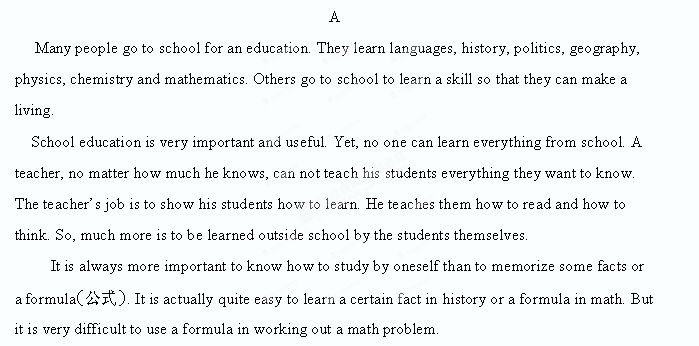 Great scientists before us didn’t get everything from school. Their teachers only showed them the way. Edison didn’t even finish primary school. But they were all so successful. They invented so many things for mankind. The reason for their success is that they knew how to study. They read books that were not taught at school. They would ask many questions as they read. They did thousands of experiments. They worked hard all their lives, wasting not a single moment. Above all, they knew how to use their brain.
People go to school to _________.
| A.learn several subjects | B.make a living |
| C.get an education | D.learn from teachers |
According to the passage, the most important thing a teacher should do is _________.
| A.to teacher his students everything he knows |
| B.to teach the students how to think |
| C.to know everything they want to know |
| D.to teach the students how to work out a math problem |
To work out a math problem, you need to know _________.
| A.only a certain formula | B.a certain fact |
| C.some facts | D.the way to solve it |
Why were many scientists so successful?
| A.They received good education. |
| B.They were very clever. |
| C.They knew how to learn. |
| D.They learned lots of facts and formulas. |
How did great scientists study?
| A.They read a lot of books and asked many questions while reading. |
| B.They did thousands of experiments. |
| C.They always worked hard and never wasted time. |
| D.All of the above. |
Jack is six. He is old enough to go to school. On the first day, his teacher teaches him three words,“l, you, he”.Then the teacher says, “I am your teacher. You are my student. He is your classmate.” When school is over, Jack goes home. His mother asks him. “What does your teacher teach you today?”Jack says with a smile(微笑),“Listen, Mum and Dad, I am your teacher.
You’re my student. He is your classmate.”His mother says,“N0, dear. You’re wrong.”Then she says,“I am your mother. You’re my son. He’s your father.”The next day. Jack’s teacher asks Jack to make sentences(造句)with“I, you and he”.Jack stands up and says. “l’m your mother. You’re my son. He is your father.”All the students in Jack’s class laugh(笑).Who teaches Jack new words?
A. His friend. B. His teacher. C. His motherHow many words does he teach?
A.2 B.3 C.4Does Jack understand(理解)what his teacher teaches?
A. Yes, he does.
B.N0, he doesn’t.
C.N0, but he understands what his mother says.What do you think of the boy?
A. He is kind. B. He is clever. (聪明) C. He is foolish.(愚蠢)Who is laughing?
A. His mother. B. His teacher. C. His classmates.
| Paula |
Monday |
Tuesday |
Wednesday |
Thursday |
Friday |
| gets up |
7:10 a.m. |
7:10 a.m. |
7:10 a.m. |
7:10 a.m. |
7:10 a.m. |
| morning |
school |
school |
school |
school |
school |
| lunch |
Pizza |
rice |
rice |
rice |
rice |
| afternoon |
yo-yo |
table tennis |
table tennis |
table tennis |
soccer |
| evening |
Homework |
homework |
Television |
homework |
clothes |
| goes to sleep |
10:15 p.m. |
10:15 p.m. |
10:15 p.m. |
10:15 p.m. |
10:15 p.m. |
On____________, Paula usually gets up at 7:10 a.m.
A. Thursdays B. Wednesdays C. weekdaysPizza is a kind of____________.
A. drink B. fruit C. foodPaula’s favorite sport is___________. ‘
A. soccer B. table tennis C. yo-yoOn Wednesday evenings Paula usually___________.
A. watches TV B. does her homework C. washes her clothesWhich is right?
A. Paula usually has pizza for lunch.
B. Paula goes to bed before ten o’clock.
C. Paula goes to school from Monday to Friday.
I am Peter Smith. I am from the USA.I like to play basketball and volleyball. I can speak Chinese, but not much. I am in the school basketball club. I am not busy on Tuesday afternoon and Friday afternoon. I want to play basketball and speak Chinese with Chinese-speaking students. Please call me at 13899495387.
I am Jack Liu. I am from China. I like to play ping-pong and soccer. I like basketball, too.I can speak English, but not very well. I am in the school soccer club. I have time on Monday afternoon and Friday afternoon. I want to talk to English-speaking students. My phone number is 13348954621.Peter Smith is an American student, and he plays basketball.
Peter has time on Wednesday and Tuesday afternoon.
Jack is a Chinese-speaking student. He wants to talk to an English speaker.
Jack and Peter can meet on Friday.
The two boys aren’t from the same country.
 粤公网安备 44130202000953号